
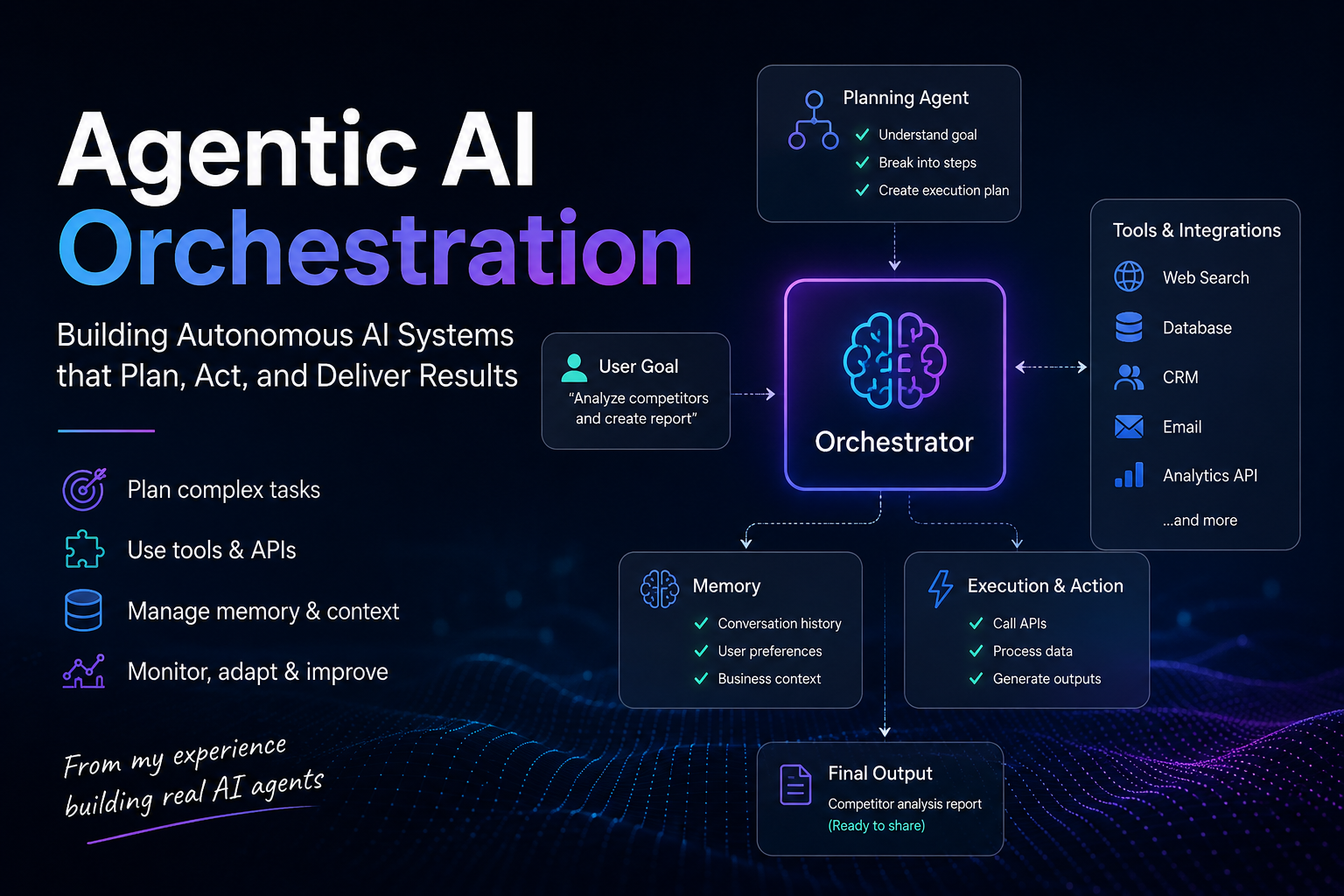
Artificial Intelligence is rapidly moving beyond simple chatbots and prompt-response systems. Modern AI applications are becoming more autonomous, capable of planning tasks, making decisions, using tools, and coordinating multiple actions to achieve a goal.
At the heart of these intelligent systems lies Agentic AI Orchestration.
Without orchestration, even the most advanced AI models are limited to generating responses. With orchestration, they can execute workflows, coordinate tools, manage memory, and solve complex problems autonomously.
In this guide, we’ll explore what Agentic AI Orchestration is, how it works, its architecture, benefits, challenges, and how developers can implement it in real-world applications.
Table of Contents
What Is Agentic AI Orchestration?
Agentic AI Orchestration is the process of coordinating AI agents, tools, memory systems, APIs, and workflows to achieve a specific objective.
Think of it as the “operating system” of an AI agent.
Instead of simply responding to a prompt, an orchestrated AI system can:
- Break complex tasks into smaller steps
- Decide which tools to use
- Retrieve information from memory
- Coordinate multiple AI agents
- Handle failures and retries
- Complete tasks autonomously
Simple Example
When a user says:
“Find the cheapest flight to Mumbai next weekend and email me the options.”
An orchestrated AI system can:
- Understand the goal
- Search flight APIs
- Compare prices
- Filter suitable options
- Generate a summary
- Send an email
All without requiring multiple user prompts.
Why Agentic AI Orchestration Matters
Most AI applications fail because they rely on a single LLM response.
Real-world business workflows require:
- Multiple decisions
- Tool usage
- Memory management
- Data retrieval
- Error handling
This is where orchestration becomes critical.
Without Orchestration
User → LLM → Response
With Orchestration
User
 ↓
Planner Agent
 ↓
Memory System
 ↓
Tool Selection
 ↓
API Execution
 ↓
Verification
 ↓
Final Response
The result is a more reliable and intelligent system.
Core Components of Agentic AI Orchestration
1. Large Language Model (LLM)
The LLM acts as the reasoning engine.
Responsibilities include:
- Understanding user intent
- Planning actions
- Making decisions
- Generating outputs
Popular models include:
2. Planning Layer
Before taking action, the AI creates an execution plan.
Example:
User Goal:
Generate a competitor analysis report.
Plan:
- Identify competitors
- Gather company data
- Analyze strengths
- Create report
- Export PDF
This planning capability makes Agentic AI significantly more powerful than traditional chatbots.
3. Tool Orchestration
AI agents become useful when connected to external tools.
Examples:
- Search APIs
- Databases
- Email services
- CRM platforms
- Payment gateways
- Internal business systems
The orchestrator decides:
- Which tool to use
- When to use it
- How to process results
4. Memory Management
Agentic systems require memory to maintain context.
Memory types include:
Short-Term Memory
Stores current task information.
Long-Term Memory
Stores:
- User preferences
- Previous conversations
- Historical decisions
- Business knowledge
Without memory, agents repeatedly lose context.
5. Execution Engine
The execution engine carries out planned actions.
Responsibilities:
- API calls
- Database operations
- Workflow execution
- Retry mechanisms
This layer transforms plans into real actions.
6. Monitoring and Observability
Production AI systems need visibility.
Track:
- Token usage
- Latency
- Errors
- Tool performance
- Agent success rates
Observability is often overlooked but becomes essential as systems scale.
Agentic AI Orchestration Architecture
A modern architecture typically looks like this:
User
 │
 ▼
 Orchestrator
 │
 ├── Planner Agent
 │
 ├── Memory Layer
 │
 ├── Tool Manager
 │
 ├── Knowledge Base
 │
 ├── API Connectors
 │
 └── Monitoring System
 │
 ▼
 Final Output
The orchestrator coordinates every component involved in completing the task.
Single-Agent vs Multi-Agent Orchestration
Single-Agent Orchestration
One AI agent handles everything.
Advantages
- Easier implementation
- Lower costs
- Simpler debugging
Best For
- Customer support
- Content generation
- Internal assistants
Multi-Agent Orchestration
Multiple specialized agents collaborate.
Example:
Research Agent
Collects information.
Analysis Agent
Processes findings.
Writing Agent
Creates final content.
Review Agent
Validates output quality.
This structure resembles a real human team.
Real-World Applications of Agentic AI Orchestration
Customer Support Automation
An orchestrated support agent can:
- Verify users
- Check account status
- Create tickets
- Process refunds
- Escalate issues
All within one conversation.
AI Software Development
AI coding assistants can:
- Generate code
- Run tests
- Fix bugs
- Review pull requests
- Deploy applications
This is becoming one of the fastest-growing use cases.
Sales Automation
Agents can:
- Identify prospects
- Gather company information
- Send outreach emails
- Schedule meetings
- Update CRM systems
Marketing Operations
AI agents can:
- Research keywords
- Generate blog content
- Create social posts
- Analyze competitors
- Optimize campaigns
Business Intelligence
An orchestrated AI system can:
- Query databases
- Generate reports
- Visualize metrics
- Recommend actions
without requiring manual analysis.
Popular Agentic AI Orchestration Frameworks
LangGraph
One of the most popular frameworks for production-grade agent workflows.
Features:
- Stateful workflows
- Graph-based execution
- Human-in-the-loop support
- Robust error handling
Best for complex enterprise applications.
AutoGen
Designed for multi-agent collaboration.
Useful when:
- Multiple agents need to work together
- Research tasks require specialization
- Agent conversations drive outcomes
CrewAI
Focuses on role-based AI teams.
Examples:
- Researcher
- Writer
- Editor
- Manager
Simple and developer-friendly.
Semantic Kernel
Popular among enterprise developers.
Benefits:
- Strong Microsoft ecosystem integration
- Plugin architecture
- Memory support
Challenges of Agentic AI Orchestration
Hallucinations
Agents may make incorrect decisions.
Solution
Use:
- Retrieval-Augmented Generation (RAG)
- Tool validation
- Human review
Cost Explosion
Complex workflows can consume many tokens.
Solution
Optimize:
- Tool usage
- Context size
- Model selection
Workflow Failures
External APIs may fail.
Solution
Implement:
- Retry mechanisms
- Fallback systems
- Checkpoints
Security Risks
Autonomous systems often access sensitive data.
Solution
Use:
- Permission controls
- Audit logging
- Human approval for critical actions
Best Practices for Agentic AI Orchestration
Start With a Single Workflow
Avoid building a multi-agent system immediately.
Add Human Oversight
Require approvals for:
- Payments
- Financial decisions
- Sensitive operations
Use Specialized Agents
Smaller focused agents usually outperform one massive agent.
Monitor Everything
Track:
- Success rates
- Tool usage
- Costs
- User satisfaction
Design for Failure
Every API call should have:
- Retries
- Timeouts
- Fallback behavior
Future of Agentic AI Orchestration
The next generation of AI applications will be orchestrated systems rather than standalone chatbots.
We are moving toward:
- Autonomous software engineers
- AI business operators
- AI customer service teams
- AI research assistants
- Multi-agent enterprise platforms
As AI models improve, orchestration will become the defining factor that separates simple AI applications from truly autonomous systems.
Conclusion
Agentic AI Orchestration is the foundation of modern autonomous AI systems. It coordinates planning, memory, tools, workflows, and multiple agents to transform AI from a conversational assistant into an intelligent problem-solving system.
Whether you’re building customer support automation, AI coding assistants, marketing workflows, or enterprise applications, effective orchestration is what enables AI to deliver real-world business value.
As organizations increasingly adopt autonomous AI systems, understanding Agentic AI Orchestration will become one of the most important skills for developers, architects, and technology leaders in 2026 and beyond.