Artificial Intelligence has changed how developers, businesses, students, and content creators work every day. Among the many AI assistants available today, Anthropic AI tools have become one of the most trusted options for coding, research, document analysis, and enterprise automation.
At the same time, many users search for uncensored AI tools that allow fewer restrictions for creative writing, roleplay, brainstorming, and experimental use cases.
But what exactly is the difference?
In this guide, we’ll compare Anthropic AI tools with uncensored AI tools, discuss their strengths and weaknesses, and help you decide which AI solution fits your workflow.
Table of Contents
What Are Anthropic AI Tools?
Anthropic AI tools are AI applications powered by Anthropic’s Claude family of language models. They focus heavily on:
- Safety
- Accuracy
- Long-context understanding
- Responsible AI
- Enterprise reliability
These tools are designed to minimize hallucinations while providing high-quality answers across coding, writing, legal analysis, customer support, and document processing.
Common use cases include:
- Software development
- Code review
- Business documentation
- Research assistance
- Knowledge management
- Customer service automation
What Are Uncensored AI Tools?
Unlike mainstream AI assistants, uncensored AI tools usually have fewer content restrictions.
Many users prefer them for:
- Fiction writing
- Character roleplay
- Creative storytelling
- Open brainstorming
- Experimental conversations
However, fewer restrictions often come with trade-offs such as reduced safety, inconsistent accuracy, and limited enterprise adoption.
Anthropic AI Tools vs Uncensored AI Tools
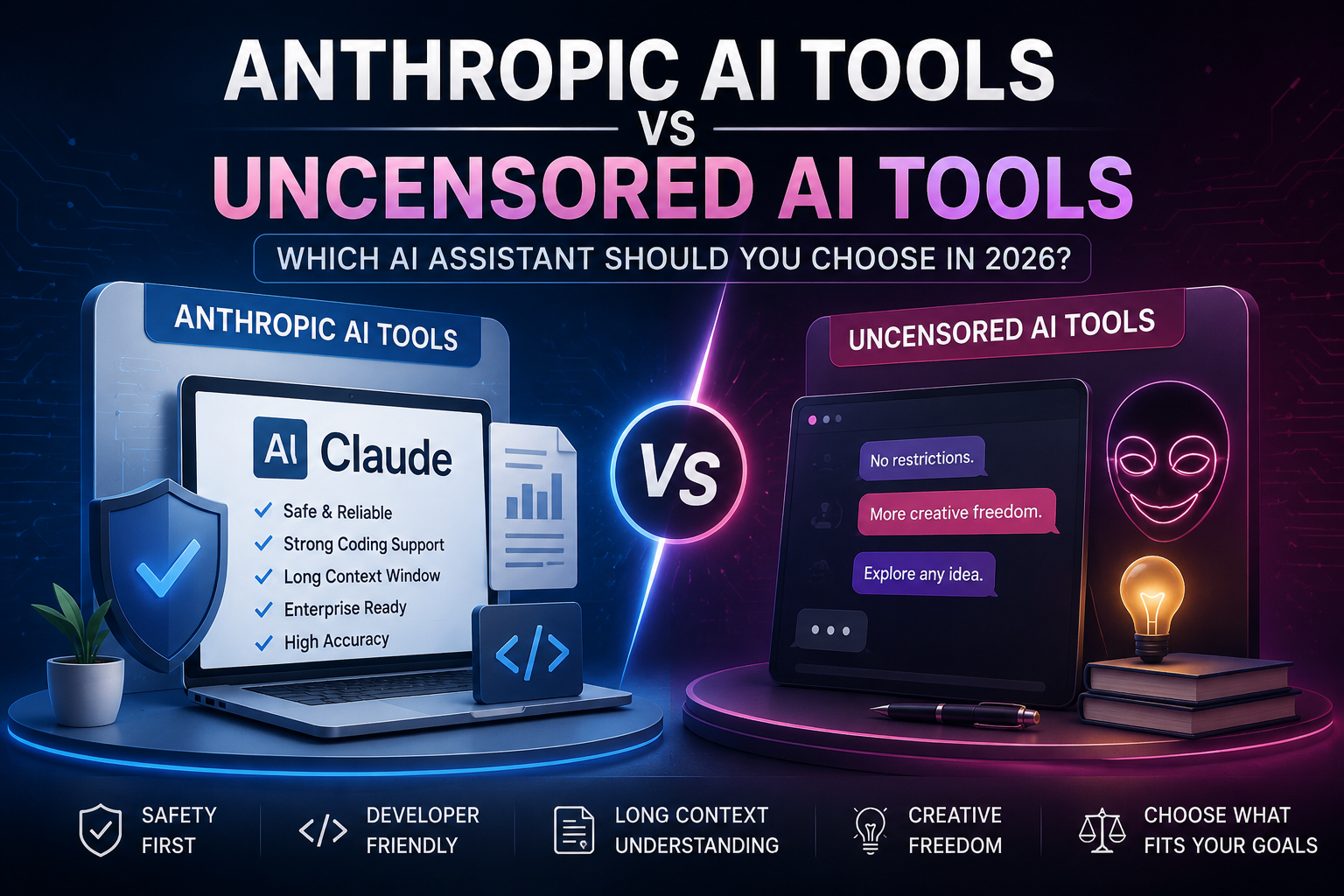
| Feature | Anthropic AI Tools | Uncensored AI Tools |
|---|---|---|
| Enterprise Ready | Yes | Usually No |
| Strong Coding Support | Excellent | Depends on Model |
| Long Context Window | Excellent | Varies |
| Safety Features | High | Minimal |
| Business Compliance | Strong | Limited |
| Creative Freedom | Moderate | High |
| Risk of Harmful Outputs | Low | Higher |
Why Developers Prefer Anthropic AI Tools
Many developers are moving toward Anthropic AI because of its reliable coding assistance.
Popular tasks include:
- Explaining complex code
- Refactoring projects
- Debugging errors
- Writing documentation
- API integration
- SQL optimization
- Security reviews
Instead of generating code blindly, Claude often explains why a solution works, making it valuable for learning as well.
Benefits of Using Anthropic AI Tools
1. Better Code Quality
Developers can generate cleaner and more maintainable code.
Examples:
- Python
- JavaScript
- TypeScript
- React
- Node.js
- Java
- Go
2. Large Context Window
One of the biggest strengths of Anthropic AI tools is handling very large documents.
This allows users to upload:
- PDFs
- Research papers
- Entire codebases
- Long reports
- Contracts
without losing context.
3. Enterprise Security
Businesses value:
- Privacy controls
- Safer responses
- Lower hallucination rates
- Responsible AI behavior
These features make Anthropic AI attractive for companies working with sensitive information.
When Should You Use Uncensored AI Tools?
Despite their limitations, uncensored AI tools have their place.
They’re often preferred for:
- Fantasy writing
- World building
- RPG campaigns
- Character conversations
- Experimental prompts
- Brainstorming unusual ideas
For creators, these tools can provide more freedom than safety-focused AI assistants.
Potential Risks of Uncensored AI Tools
Before choosing an uncensored AI tool, consider the following:
- Less reliable information
- Higher chance of misinformation
- Reduced content filtering
- Limited business compliance
- Possible legal or ethical concerns
For professional work, verification is always recommended.
Which One Is Better?
The answer depends on your goals.
| Your Goal | Recommended Choice |
|---|---|
| Software Development | Anthropic AI Tools |
| Business Automation | Anthropic AI Tools |
| Research | Anthropic AI Tools |
| Document Analysis | Anthropic AI Tools |
| Customer Support | Anthropic AI Tools |
| Creative Fiction | Uncensored AI Tools |
| Character Roleplay | Uncensored AI Tools |
| Experimental Conversations | Uncensored AI Tools |
Best Practices When Using AI Tools
Whether you’re using Anthropic AI tools or uncensored AI tools:
- Verify important facts.
- Never share confidential data unnecessarily.
- Review AI-generated code before deploying.
- Edit AI-written content to match your tone.
- Use AI as an assistant not a replacement for critical thinking.
Frequently Asked Questions
Are Anthropic AI tools free?
Some Anthropic-powered services offer free access with usage limits, while advanced features are typically available through paid subscriptions or API pricing.
Are uncensored AI tools illegal?
No. Most uncensored AI tools are legal to use. However, users remain responsible for complying with local laws, platform terms, and ethical guidelines.
Which AI tool is better for coding?
For most developers, Anthropic AI tools are considered among the strongest options because they provide detailed explanations, code reviews, debugging assistance, and long-context understanding.
Can businesses use uncensored AI tools?
Some businesses may use them for creative brainstorming, but safety-focused AI platforms are generally preferred for customer-facing applications and sensitive data.
Final Thoughts
Both Anthropic AI tools and uncensored AI tools serve different audiences.
If your priority is coding, research, business productivity, and reliable document analysis, Anthropic AI tools are usually the better choice. They emphasize accuracy, safety, and enterprise readiness.
If your focus is unrestricted creativity, storytelling, roleplay, or experimental conversations, uncensored AI tools may offer greater flexibility but they should be used thoughtfully, with an understanding of their limitations.
The best AI tool isn’t simply the one with the fewest restrictions; it’s the one that aligns with your goals while delivering trustworthy, effective results.