
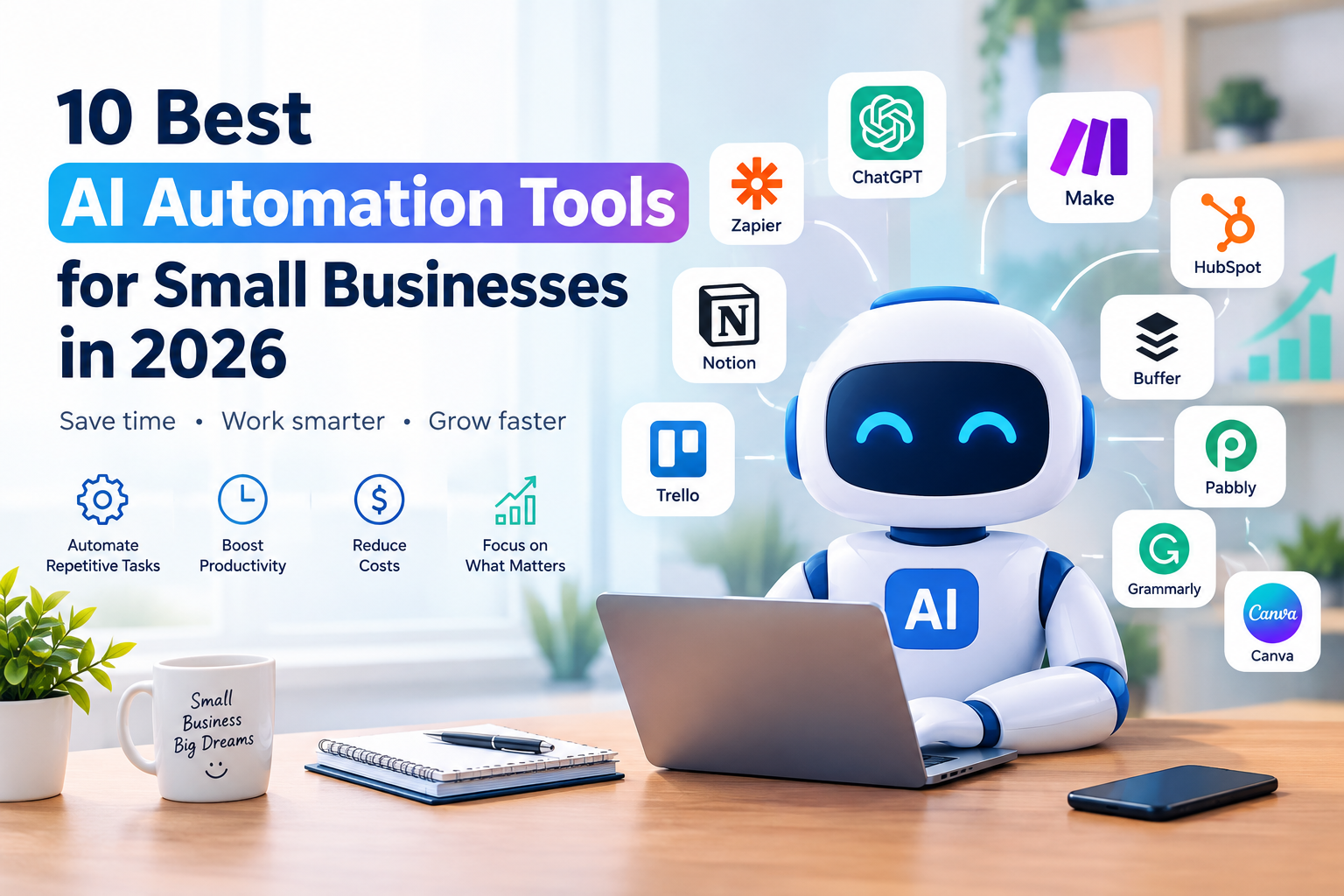
If you want to run your business faster by managing multiple tasks at once to grow your small business efficiently, you can take help from an AI automation tool for marketing, customer support, sales, content creation, and daily operations. Handling everything manually can consume valuable time and resources. This is where AI automation tools for small businesses can make a real difference.
In this article, we explore the 10 best AI automation tools for small businesses in 2026 to help you find the right solutions for your needs.
Table of Contents
1. ChatGPT
ChatGPT helps businesses generate content, brainstorm ideas, draft emails, summarize documents, and assist with everyday tasks. It can also support customer communication and workflow planning.
Best for: Content creation, research, writing, and business productivity.
2. Zapier
Zapier connects different apps and automates workflows without requiring extensive coding. For example, you can automatically send form submissions to a spreadsheet or create tasks when a new customer registers.
Best for: Connecting apps and automating repetitive tasks.
3. Make
Make allows users to build visual workflows that connect multiple applications and services. It is useful for creating more advanced automations with conditional steps and data processing.
Best for: Visual workflow automation and complex processes.
4. HubSpot
HubSpot offers CRM, marketing, sales, and customer service features. Its automation capabilities help businesses manage leads, organize customer information, and automate follow-up activities.
Best for: Customer relationship management and sales automation.
5. Notion
Notion combines notes, documents, databases, and project management in one workspace. Its AI features can help summarize information, organize ideas, and speed up documentation.
Best for: Team collaboration, documentation, and project organization.
6. Trello
Trello helps teams organize projects using boards, lists, and cards. Its automation features can handle routine actions, while AI-assisted workflows can help teams manage tasks more efficiently.
Best for: Task management and team productivity.
7. Buffer
Buffer helps businesses plan, schedule, and manage social media content. It can also assist with generating post ideas and adapting content for different social platforms.
Best for: Social media scheduling and marketing.
8. Pabbly Connect
Pabbly Connect connects applications and automates workflows between them. It can help small businesses transfer data, trigger actions, and reduce repetitive administrative work.
Best for: App integrations and business process automation.
9. Grammarly
Grammarly helps improve writing by checking grammar, clarity, tone, and readability. Its AI writing assistance can be useful when preparing emails, website copy, marketing messages, and business documents.
Best for: Professional writing and communication.
10. Canva
Canva makes it easier to create social media graphics, presentations, advertisements, and other marketing materials. Its AI-powered features can help businesses generate content ideas and speed up visual design.
How to Choose the Right AI Automation Tools for Small Businesses
Before investing in any software, consider your business goals and daily challenges. The best AI automation tools for small businesses are the ones that solve real problems without making your workflow unnecessarily complicated.
Here are a few factors to consider:
- Ease of use: Choose tools that you and your team can learn quickly.
- Pricing: Compare free plans, paid subscriptions, and usage limits.
- Integrations: Make sure the tools work with your existing software.
- Automation features: Prioritize tasks that consume the most time.
- Security: Review data privacy policies and access permissions before connecting business accounts.
Start with one or two tools, measure the time saved, and expand your automation setup as your business grows.
Final Thoughts
AI is making it easier for small businesses to compete, work efficiently, and deliver better customer experiences. From ChatGPT and Canva to Zapier and HubSpot, these tools can help automate different parts of your business.
The best AI automation tools for small businesses depend on your budget, industry, and specific requirements. You do not need to adopt every tool on this list. Start with the tasks that take up the most time, choose suitable software, and build your automation workflow step by step.
With the right approach, AI automation can help your small business save time, improve productivity, and focus more on sustainable growth.
Note: Features, integrations, and pricing may change. Check each tool’s official website for its latest plans and capabilities before choosing a subscription.
Frequently Asked Questions (FAQs)
1. What are AI automation tools for small businesses?
AI automation tools for small businesses are software applications that use artificial intelligence and automated workflows to handle repetitive tasks. They can help with content creation, email management, customer support, marketing, sales, and daily business operations.
2. What are the best AI automation tools for small businesses in 2026?
Some of the best AI automation tools for small businesses in 2026 include ChatGPT, Zapier, Make, HubSpot, Notion, Trello, Buffer, Pabbly Connect, Grammarly, and Canva. The right choice depends on your business needs, budget, and preferred features.
3. Are there any free AI automation tools for small businesses?
Yes, several tools offer free plans or limited free features. ChatGPT, Canva, Grammarly, and Notion are examples worth exploring. Zapier and other automation platforms may also offer limited free usage. Check their official websites for current plan details and restrictions.
4. How can AI automation help a small business?
AI automation can reduce manual work, save time, improve productivity, organize customer data, speed up content creation, and automate repetitive workflows. This allows small business owners to focus more on customer relationships and business growth.
5. Which AI automation tool is best for beginners?
ChatGPT is a good starting point for writing, brainstorming, and everyday productivity. For connecting different applications without coding, Zapier is another beginner-friendly option. Your best choice depends on which tasks you want to automate.
6. Can AI automation tools reduce business costs?
Yes, AI automation tools can help reduce costs by minimizing repetitive manual tasks, improving efficiency, and reducing some administrative workload. However, savings depend on subscription costs, setup requirements, usage limits, and the type of work being automated.
7. Do I need coding skills to use AI automation tools?
No, many AI automation tools offer no-code or low-code interfaces. Platforms such as Zapier and Make allow users to create workflows visually. More advanced integrations or custom automations may require technical knowledge.
8. How do I choose the right AI automation tools for my small business?
Start by identifying the tasks that consume the most time. Compare tools based on features, pricing, ease of use, integrations, scalability, and data security. Test free plans where available and select the tools that provide the most practical value for your business.