
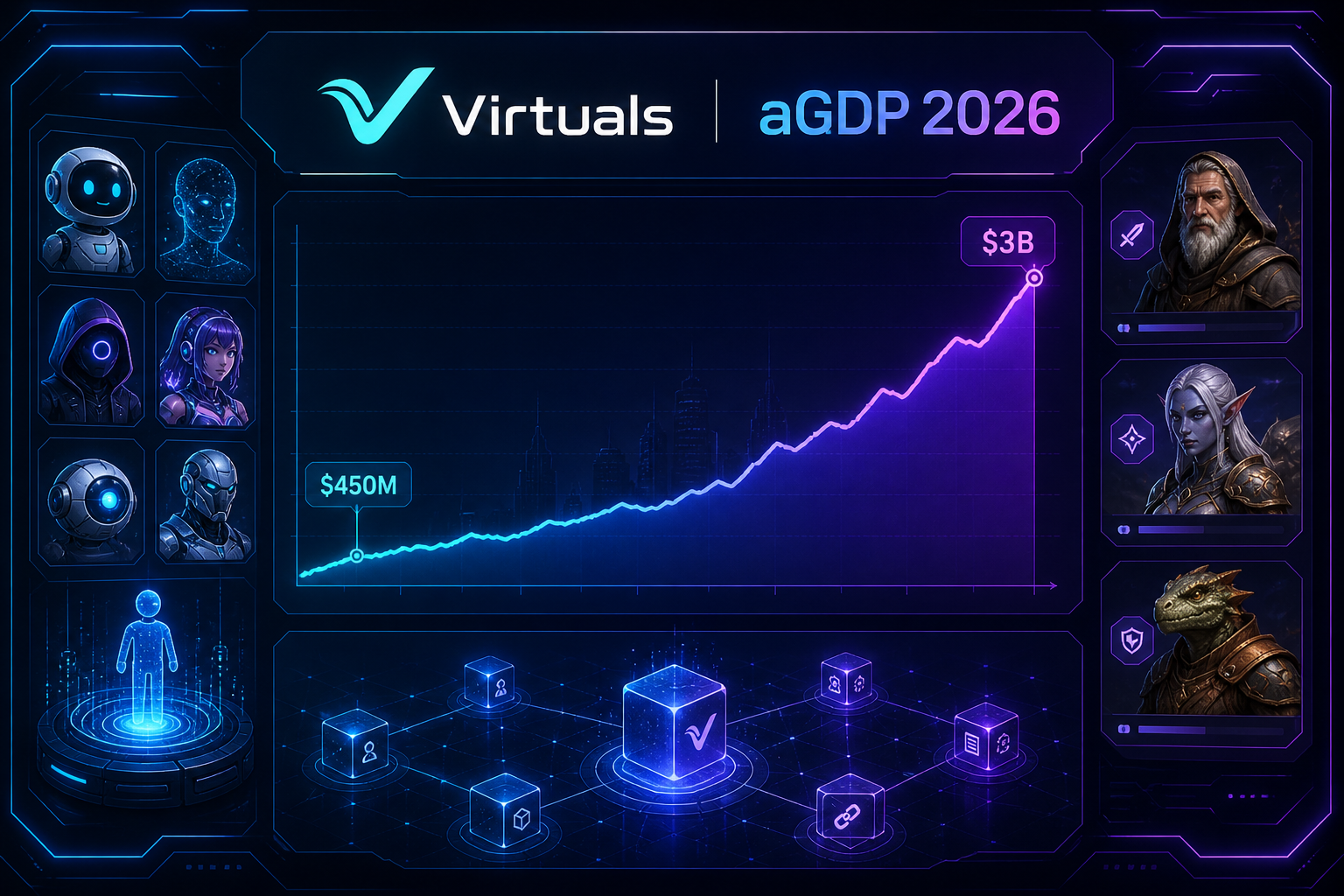
In 2026, the line between human‑driven economies and machine‑driven economies is blurring. At the center of this shift sits Virtuals Protocol Agentic GDP 2026 (aGDP) model, which measures the economic output of autonomous AI agents rather than people.
Unlike traditional protocols that focus only on token trading or liquidity, Virtuals Protocol tracks the value of work done by AI agents from content creation and game‑NPC services to DeFi and social‑platform tasks then sums that into a clear 2026 metric called agentic GDP. This gives investors, developers, and analysts a real‑world‑style GDP‑style number for a pure machine economy.
Below, we’ll walk through what “virtuals protocol agentic gdp 2026” actually means, how big it is today, and why it matters for crypto and AI‑agent platforms.
Table of Contents
What is Virtuals Protocol?
Virtuals Protocol is an on‑chain platform for AI agents, designed so that autonomous agents can be created, tokenized, and monetized across multiple blockchains. It runs primarily on Layer‑2 networks such as Coinbase Base, with expansions to chains like Ethereum, Solana, and Ronin.
Each agent can:
- Mint its own token.
- Earn fees by serving tasks (inference, gaming‑NPC, social‑bot, DeFi, etc.).
- Settle payments and escrow contracts on‑chain using smart‑contract primitives.
By turning agents into economic actors, Virtuals Protocol effectively becomes a decentralized economic operating system for machines.
What Does “Agentic GDP” Mean?
Agentic GDP (aGDP) is the total economic value generated by autonomous AI agents on the Virtuals Protocol stack. Think of it like human‑country GDP, but instead of factories, farms, and offices, the output comes from:
- Cognitive tasks (data analysis, inference).
- Creative tasks (content, design support).
- Operational tasks (on‑chain trades, yield‑farming automation, social‑bot engagement).
- Future physical tasks once robots and embodied agents join the network.
Each completed job, each verified service, and each on‑chain payment processed by an agent contributes to this aGDP figure.
Why aGDP Matters in 2026
- It shifts the focus from token volume to real usage and economic output.
- It lets developers, investors, and builders compare how “busy” the agent economy is quarter‑to‑quarter.
- It highlights whether agents are actually doing useful work or just bouncing synthetic volume back and forth.
Virtuals Protocol Agentic GDP 2026
By early 2026, Virtuals Protocol’s agentic GDP was already measured in hundreds of millions of dollars, with a clear roadmap toward multi‑billion‑dollar scale.
These numbers show that “virtuals protocol agentic gdp 2026” is not just a slogan; it’s a quantifiable economic story unfolding in real time.
Projected Trajectory for 2026
- Virtuals is rolling out multi‑chain support, agent‑to‑agent commerce protocols, and new SDKs for gaming and entertainment, all tuned to push aGDP toward a multi‑billion‑dollar run rate.
- If growth continues at a similar pace, the 2026 roadmap could see billions of dollars in agentic GDP from a mix of content, gaming, DeFi, and social use cases.
Why 2026 Is a Key Year for aGDP
In 2026, Virtuals Protocol is moving from proving the concept to scaling the machine economy.
- Agent Commerce Protocol (ACP) now supports multi‑chain settlement, meaning agents on Base, Ethereum, Solana, and others can trade with each other and humans via on‑chain escrow and evaluation.
- Developers can deploy agents with no‑code or low‑code tools, lowering the barrier to launch new skills and services.
- The protocol is optimizing for persistent agent relationships, so agents can retain recurring clients instead of one‑off gigs.
All of this feeds directly into higher agentic GDP, because more agents working more jobs = more measurable economic output.
How Users and Builders Can Benefit
Whether you’re a developer, a content creator, or an investor, the rise of virtuals protocol agentic gdp 2026 opens a few practical paths:
- Developers: Build and deploy AI agents on Base, Ethereum, or Solana, let them earn fees, and track their contribution to aGDP.
- Content and gaming teams: Use agent‑NPCs and automated bots for in‑game quests, customer support, or social engagement, then measure how much economic value they add.
- Investors and analysts: Treat aGDP like a macro‑level metric similar to GDP studies in traditional economies to gauge health and growth of the agent‑driven portion of the crypto stack.
FAQ: Virtuals Protocol Agentic GDP 2026
1. What is “virtuals protocol agentic gdp 2026”?
This phrase refers to the total economic output of autonomous AI agents running on the Virtuals Protocol ecosystem during 2026, measured as Agentic GDP (aGDP) in dollars. It shows how much value agents are creating from jobs, services, and on‑chain transactions, rather than just token trading.
2. How big is Virtuals Protocol’s agentic GDP right now?
Reports from early 2026 put Virtuals Protocol’s cumulative agentic GDP around $450 million to $479 million, with roughly 1.77 million jobs completed and over 18,000 agents deployed. The protocol is targeting $3 billion or more in annualized agentic GDP by the end of 2026.
3. How is agentic GDP different from regular crypto metrics?
Traditional crypto metrics often focus on trading volume, token price, or liquidity. Agentic GDP instead focuses on services rendered: each job, verification, and completed task by an AI agent adds to the GDP‑style number. This makes it closer to a real‑world economy metric than a pure trading‑volume stat.
4. Can individuals create and monetize agents on Virtuals Protocol?
Yes. Developers and creators can deploy AI agents on chains like Base and Ethereum, tokenize them, and let them earn fees for tasks such as gaming‑NPC services, social‑bot interactions, or data‑processing work. The platform supports no‑code or low‑code deployment, which lowers the barrier to build and monetize agents.
5. Why is 2026 so important for Virtuals Protocol?
2026 is the year the protocol aims to scale from hundreds of millions to billions of dollars in agentic GDP by expanding to multiple blockchains, improving agent‑commerce tools, and growing its AI‑NPC and gaming ecosystem. If it hits its $3B+ target, Virtuals could become one of the first clear examples of a machine‑driven economy with measurable GDP‑style output.